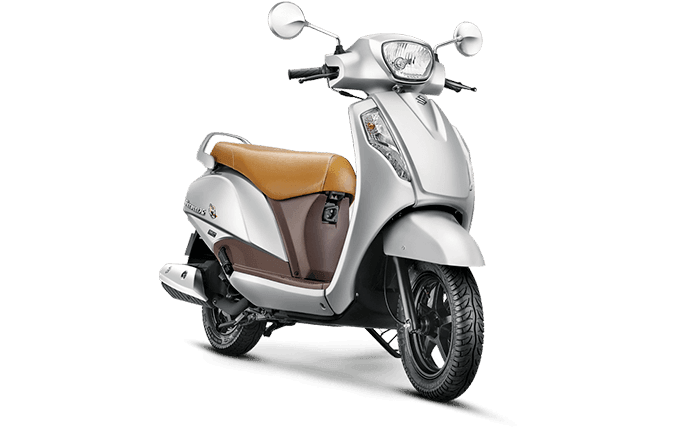
SUZUKI ACCESS 125 IS SET TO RECEIVE MAJOR FEATURES AND STYLING UPDATES SOON. IT ALREADY COMES EQUIPPED WITH COMBINED BRAKING SYSTEM (CBS).


Revo is a cub model motorcycle brand of Honda in Indonesia. But, in Thailand the name Revo will be owned by Suzuki. Suzuki Smash Revo, officialy called FK110SD-E model in Suzuki. Smash Revo sounds commercially much better then Smash. Besides in Thailand, Smash Revo also sold in Vietnam. In Indonesia, it's sold in the name of Suzuki New Smash.
The weight and handling of the Suzuki Smash Revo is what you can expect from a 95 kilo, and a wheelbase of 1.23 meter. Nothing special about the handling of the bike, all we had the feeling that the 110 cc engine was a bit more powerful then the average 110 cc. Maybe the source for this extra power is the Mikuni VM-18 carburetor, the Mikuni VM-18 carburetor is often used in racing motorcycles. There are also special racing kits available for this Mikuni carburetor.
As all motorcycles in this price class, the Suzuki Smash Revo comes with electric starter and rear swing-arm with 2 coil spring the front suspension is a regular telescopic, coil Spring with oil damper. For brakes the Smash Revo has a single front Disc Brake and a rear drum brake. From the showroom the Smash Revo has spoked wheels, some dealers are maybe willing to exchange this for light metal wheels. Suzuki is using a 70/90-17 33P tire on the front wheel and a 80/90-17 43P tire on the rear wheel.
For fuel this Suzuki bike has a 4.5 liter Fuel Tank Capacity, and for fuel type it is standard Unleaded Petrol (91 Octance).
For performance Maximum power the Smash Revo can deliver 9.8 PS, at 9,000 rpm. With a Maximum Torque 1.0 kg/m at 7,000 rpm. The engine is a 110 cc 4-Strong, Single Overhead Camshaft model. Air Cooled with a bore x stroke of 53.5 x 48.8 mm with DC-CDI ignition. For lubrication we see the proved technology of SALCS (Suzuki Advanced Lubrication Cooling System) again.
Most sexiest naked bike I have ever seen……!!
You have never seen, much less ridden, anything like the all new B-King. As the Hayabusa's raucous alter ego, if features a lightly modified version of that bike's new 2008 engine, complemented by its own state-of-the-art chasis and suspension ssytems. But its the B-king's aggressive "Don't mess with me" styling that really raises eyebrows, with an imposing engine exposed for all the world to see and twin exhaust pipes that suggest a truly onof-a-king sport riding experience. One look and you'll see, one ride and you'll know: there's nothing like the B-king. Nothing.
Technicial Specifications:
Engine: 1340cc, 4-stroke,4-cylinder, liquid-cooled, DOHC, 16-valve
Fuel System: Suzuki Fuel Injection
Ignition: Digital/Transistorized
Starter: Electric
Transmission: 6-speed, constant mesh
Final Drive: Chain
Front Suspension: Inverted telescopic, coil spring, full adjustable spring reload, adjestable rebound damping and adjustable compression damping
Rear Suspension: Link-type, oil damped, fully adjestable spring preload, adjustable compression and rebound damping
Front Brakes: Dual hydraulic disc
Rear Brake: Single hydraulic disc
New Desing
Redesigned instrument cluster now features four analog meters for speedometer, tachometer, fuel gauge and water temperature with a new S-DMS mode indicator, gear position indicator and adjustable engine rpm indicator.
New Engine
New 1340cc, DOHC liquid-cooled engine with 16-valves, Twin Swirl Combustion Chambers provides 11% higher performance and smoother operation
New Suzuki SDTV fuel injection system with dual injectors per cylinder and ram air intake with large volume airbox
New S-DMS (Suzuki Drive Mode Selector) allows the rider to choose from three different engine settings depending on riding conditions or rider preferences
New lightweight titanium intake and exhaust valves with narrow 14 degree valve angle for high combustion chamber efficiency
New lightweight aluminum alloy pistons feature a revised shape and a higher compression ratio of 12.5:1 for maximum performance in all conditions.
SCEM (Suzuki Composite Electro-chemical Material) plated cylinders minimize cylinder size and improve heat dissipation and new hydraulic cam chain tensioner for reduced mechanical noise
New ventilation holes at the cylinder skirt for reduced pumping losses and increased performance
High efficiency curved radiator now features dual electric fans controlled by the ECM for increased cooling capacity. Oil cooler now has 10 rows cores for increased heat dissipation.
New large volume 4-2-1-2 exhaust system with a large capacity catalyzer, dual triangular canisters and closed loop system that meets Euro 3 and Tier 2 regulations
New Shot-peened chrome-moly steel connecting rods for maximum durability
Ion plating treatment utilizing PVD (physical vapor deposit) method is applied to piston rings providing a smoother surface treatment for increased durability, reduced friction loss and reduced oil consumption
Slick shifting 6 speed transmission working in conjunction with an innovative back torque limiting clutch for smooth and controlled downshifts
New Chassis
All new aggressive aerodynamic fairing design with low drag coefficient retains it's signature Hayabusa look and features an updated, muscular look to work with the new more powerful engine and updated chassis
New fully adjustable inverted front fork featuring DLC coated inner tubes for minimal friction resistance and outstanding suspension performance over a variety of riding conditions.
Fully adjustable rear shock absorber with a 43mm piston and 14mm rod diameter
Lightweight and rigid twin-spar aluminum frame minimizes weight while maintaining high torsional strength
New bridged aluminum alloy swingarm features a new cross-sectional shape for increased rigidity and to cope with improved rear tire grip and increased engine output
New radial-mount front brake calipers for maximum braking performance and allows for smaller 310mm front brake rotors resulting in reduced unsprung weight and improved handling
Lightweight single piston rear brake caliper working in conjunction with a new larger 260mm rear brake disc
Newly designed wheels mounted with high performance Bridgestone BT-015 tires for unmatched handling and control
Passenger seat and rear subframe are lowered for improved passenger comfort
Fuel tank height is lowered to allow riders helmet to tuck in and windscreen height is increased for improved wind protection and optimum aerodynamic efficiency with the rider in place.
Newly designed vertically stacked twin headlights provide increased light intensity, improved light distribution and match the elegant flow of the new Hayabusa styling.
LED taillight utilizes a double lens structure with a clear inner lens and a red outer lens for maximum visibility and a high quality finish.
Technical Specifications
| Engine: | 1340cc, 4-stroke, four-cylinder, liquid-cooled, DOHC, 16-valve, TSCC |
| Bore Stroke: | 81.0 x 65.0mm |
| Compression Ratio: | 12.5:1 |
| Fuel System: | Fuel Injection |
| Lubrication: | Wet sump |
| Ignition: | Digital/Transistorized |
| Transmission: | 6-speed, constant mesh |
| Final Drive: | #530 chain |
| Overall Length: | 2195mm (86.6 in.) |
| Overall Width: | 740mm (29.1 in.) |
| Overall Height: | 1170mm (46.1 in.) |
| Seat Height: | 805mm (31.7 in.) |
| Ground Clearance: | 120mm (4.7 in.) |
| Wheelbase: | 1485mm (58.5 in.) |
| Dry Weight: | 220 kg (485 lbs) |
| Suspension Front: | Inverted telescopic, coil spring, fully adjustable spring preload, adjustable rebound damping and adjustable compression damping |
| Suspension Rear: | Link-type, gas/oil damped, fully adjustable spring preload, adjustable compression & rebound damping |
| Brakes Front: | Dual hydraulic disc |
| Brakes Rear: | Single hydraulic disc |
| Tires Front: | 120/70-ZR-17 |
| Tires Rear: | 190/50-ZR-17 |
| Fuel Tank Capacity: | 21 liter (5.5 gal.) 20.0 liter (5.3 gal.) CA. model |
| Color: | Orange/Black, Black/Gray, Blue/Black |
Suzuki would be launching a new ungeared scooter during october to take on the Honda Activa which is leading the market in ungeared scooter segment. The new scooter would be with a engine capacity of 125cc and it could be one of the most fuel efficient scooters in the market.
The company is planning to introduce some new features on the scooter, which would be first in the industry. Suzuki's Vice President Mr.Atul Gupta said:
“Our research has shown that the Indian customer wants better mileage without compromising on power and aesthetics. We are working on better fuel mileage coupled with high torque (power) in our scooter.
Like motorcycles, there is a tremendous demand for higher-powered scooters in India. We would break the league with a superior product, different from the market which is currently being dominated by the 100cc automatic scooters.
We are working on certain India specific features in our R&D that would be strapped on the scooter, but cannot be revealed now.”
They are finally here. The macho 1670cc V-twin power cruiser MT-01 and the slick 998cc R1 are already lazing around in Yamaha’s garage in downtown Delhi. By the end of next month, the Jap bike maker is going to announce the price of their super bikes.
“We are putting in place the after-sales infrastructure now. It’s very important to have a solid back-up in place for these bikes. Technicians have to be specially trained to service these machines because they are highly sophisticated,” a Yamaha spokesperson said.
That’s not all. Yamaha also intends to train customers in the skills necessary to handle these superfast motorcycles. These super bikes will be sold for an estimated Rs 11-13 lakh, and when you are coughing up that amount of money, you expect the service back up to be spot-on.
Forty-five-year-old Arun Thareja, who is a super bike specialist and owns three of them, says, “People are going to go down on these bikes, so more than after-sales support, companies should be ready with spare parts like panels, indicators, panels and wind screens. And oh yes, the tyres wear out every 7,000-8,000 km, so the sales department should have a good stock ready. I think one or two service centres in each city would do.”
Even Suzuki is keen to launch their super bikes here. Says Atul Gupta, VP-marketing at Suzuki Motorcycles and Scooters India: “We are keenly studying three aspects of selling high-end bikes. One is how well can we homologate our high-end bikes for Indian conditions. Also, we are looking at what are the top cities where we see maximum sales potential and then the question of how well we manage to handle the after-sales and parts issues.”
So, companies planning to launch their top-end bikes here feel that after-sales service is what they should look into first. “We are already ensuring that Suzuki’s technical team is trained in Japan to handle those bikes who, in turn, will train our dealers in India. Training does not incur lot of cost; in fact, most Suzuki dealers have enough space, which is the biggest cost for them. But we are working out a very sound after-sales strategy for being able to sell our high-end bikes in the country,” Gupta adds.
Even Honda Motorcycles and Scooters India (HMSI) is bullish about the niche market that India offers for super bikes. Says Sanjay Gupta, senior manager, marketing at HMSI: “We will be going forward by introducing safety riding skills first. We already have simulators in place at some of our dealerships where a customer is put through various emergency situations. At present, we are putting in place the basic infrastructure before introducing the big bikes here.”
So when you have a machine that accelerates from 0-100 kph in less than three seconds and has a top speed of 300 kph, it’s imperative for bike makers to have the necessary service infrastructure in place. And who knows, on Indian roads, an ambulance service also doesn’t seem very far fetched!